Protecting cow feed and silage
March 21, 2025The most critical factor in maintaining high quality silage or protecting silage and minimizing DM loss is the control of oxygen exposure. Poor oxygen protection of silage results in higher DM losses due to shrinkage, lower sugar & starch levels, increased pH, mold & mycotoxin growth.
Harvesting
Experience has shown that particular attention needs to be paid to the stalks, as their degree of conditioning diminishes at an earlier stage than that of the kernel constituents.
The recommended dry matter content ranges from 32-36% DM. More moist crops, below 32% DM, can lead to increased effluent formation while DM levels above 36% have to be compressed with particular care.
Chopping
Short-chopped silage in the 3.5 to 12 millimeter length range; the length that is primarily used in biogas systems, but is also suitable as feed for dairy cattle. The requirements for silage chop length and processing differ widely depending on the individual farm and usage. The spectrum extends from extremely short chop lengths of between 3.5 and 12 mm all the way up with chop lengths greater than 25 mm. Broadly speaking, it is currently possible to identify three requirement groups.
Short-chopped silage.
Chop lengths of 3.5 to 12 mm fall into the short-chopped silage group. Short chopping is used for silage destined for both biogas facilities as well as feed for dairy and beef cattle. The requirement here is for homogenous, short plant material with a very fine structure. An extremely high standard of kernel processing is also called for. This silage has a low effective fibre content and is used mainly in the biogas sector. When used as cattle feed, it must be supplemented with sufficient quantities of an alternative fibrous material.
Long-chopped silage.
Classic long-chopped silage covers the chop length range from 12 to 22 mm and has been established in many countries for years. In addition to kernel processing, the key here is to increase the physically effective fibre content; however, the different feed components are not shredded as intensively as they are in the SLAGE process. Nevertheless, the improved physical effect of long-chopped silage still benefits the rumination process; only clamp compaction proved to be a shortcoming in the past.
Extra Long Chopped silage
Extremely long chop lengths of up to 30 mm. The very high degree of kernel processing and powerful grinding effect increase the amount of starch – a source of energy – available in the rumen. Furthermore, the intensive longitudinal shredding of the stalks significantly increases effective fibre levels in the silage and so improves rumination.
The perfect silage clamp
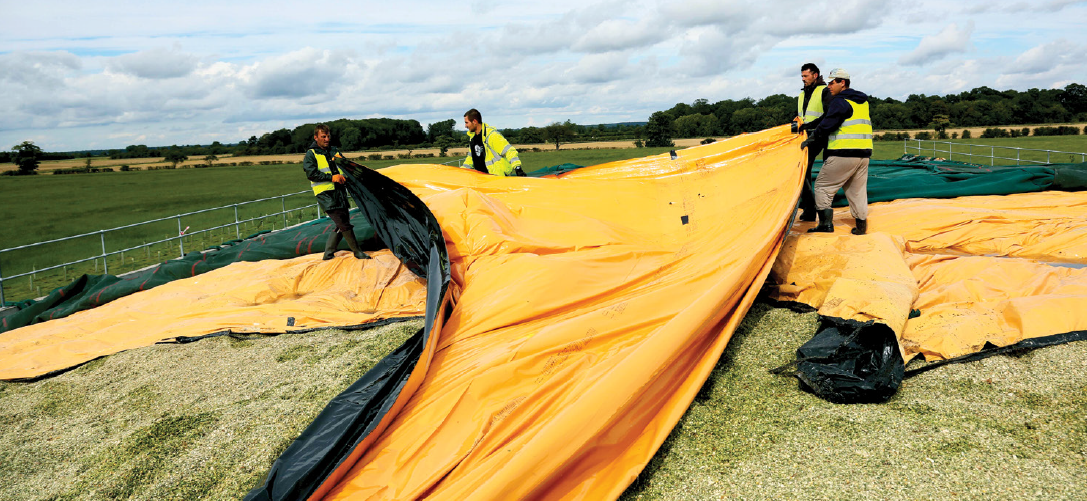
Silostop reduces DM loss, visible surface spoilage & increases aerobic stability.
How to use our system
- Inspect the silage clamp walls before applying the Wall Film. Check for damage and corrosion of the walls and floors, seal any cracks, and renew the flooring if necessary.
- Silo-stop Wall Film must be at least 2 meters wider than the height of the walls.
- Place the Silo-stop Wall Film over the wall so that 1.5 to 2 meters overlap the top of the panel. As the clamp is filled, the Wall Film tends to be pulled down, and it is essential to leave at least one meter to overlap the silage when the clamp is full. Secure the Wall Film at the base using fresh silage.
- Ensure the silage is well compacted and the surface is as flat as possible.
- Fold the Wall Film back over the silage before applying the Silo stop high oxygen barrier film.
- Do not pull the film tight. Allow the film to follow the contours of the silage surface and overlap joins in the film by at least 1.5m.
Secure covers
Covers make covering your silage clamp quick, clean and easy, and are used by thousands of farmers worldwide. Secure Covers are made from a tough, knitted HDPE, which is non-fray, strong, durable, and UV resistant and will last for many years.
Silage Covers unique construction, using our patented square-thread technology, reduces ‘wind lift’, preventing the covers from moving in the wind, so they stay in place on your clamp.
We found that simple woven netting would fray and disintegrate in our trials. Simple woven covers are very stiff and cannot follow the contours of the silage.
Secure Covers’ flexible material keeps your silage sheets in close contact with the silage surface to help maintain an airtight seal.
Secure Gravel Bags / Premium Gravel Bags
Gravel bags are easy to handle, clean, strong and durable and have a long lifespan. Unlike tires, there is no risk of ‘tire wire’, which can be deadly for your livestock.
Gravel bags are very flexible and create a much better seal along the silage clamp wall than tires.
Due to their circular shape, tires only have one point of contact against the clamp wall, whereas gravel bags have contact along their entire length, preventing oxygen from entering the clamp.
Gravel bags don’t hold water either (no more tyre juice) and can be neatly stacked on a pallet for storage when not in use.
Maximize your investment in forage crops
Growing forage can be costly and time consuming, so generating the maximum yield from the crop is critical to farm profitability. Our test results show that an investment in the Silostop Agri system can generate up to a 600% return. Using High Oxygen Barrier Films produces better fermentation, much lower DM losses, minimal surface mould, and improved aerobic stability at feedout while being easy to recycle, using less plastic and helping farms be more sustainable.
Silostop Orange
Orange clings to the silage surface eliminating air pockets and reduces surface spoilage by restricting oxygen permeation, reducing the development of moulds and undesirable bacteria, including butyric acid bacterial spores in the peripheral areas of the clamp or bunker during the storage period.
Silostop Max
Max sits against the silage surface, eliminating surface spoilage by restricting oxygen permeation and reducing the development of moulds and undesirable bacteria, including butyric acid bacterial spores in the peripheral areas of the clamp during the storage period.
Black 60
Black 60 sits against the silage surface, eliminating surface spoilage by restricting oxygen permeation and reducing the development of moulds and undesirable bacteria, including butyric acid bacterial spores in the peripheral areas of the clamp during the storage period.
HD Wall Film
High Oxygen Barrier side wall films create a barrier between the wall of a silage clamp and the silage. Protecting clamp walls from damage caused by the acids within silage and ensuring an oxygen barrier seal against the wall and in the shoulders of the clamp.
Standard Wall Film
They create a barrier between the wall of a silage clamp and the silage. Protecting clamp walls from damage caused by the acids within silage and ensuring an airtight seal against the wall and in the shoulders of the clamp.
Reusable Secure Covers
Anti UV Cover
Anti-UV creates a UV barrier providing 100% shading for non UV stable silage films whilst also protecting films from bird and wildlife damage and holding them in place against the silage surface. When combined with Silostop Orange the complete system generates up to 60% less plastic waste than conventional covering systems.
Secure Covers
To protect silage and feed storage bags from bird and wildlife damage while holding films in place against the silage surface. Secure Covers unique three dimensional knitted design and filament structure is industry leading in its wind lift mitigation staying in place 9 times longer on the surface of a silage sheet in wind tunnel trials compared to conventional woven netting.
Open Net
Open Net protect silage films, silage bales, and feed storage bags from bird and wildlife damage while holding films in place against the silage surface creating the ideal anaerobic conditions in the clamp or bunker.
Standard Gravel Bag
Standard Gravel Bags are placed on top of Secure Covers Open Net to hold the netting and silage films in place ensuring an airtight seal around the edges of the clamp and against the silage surface.