Dairy Barn lighting
October 17, 2025Better light, better life: Prosperity and profitability
Barn Lighting and Its Effect on Milking Cow Productivity: As a farmer, your daily concerns revolve around the welfare and productivity of your animals. Animal health is a key priority. The right choices must be made to balance welfare and profitability.
Lighting is a topic you may never think about, but barn lighting is an essential component for livestock. Without good lighting, you can’t do your job properly and you can’t miss vital signals that indicate your cattle’s health. Do you know how much light can affect milk production?
AgriLight has been conducting research on the effects of light on animal welfare and productivity for over 15 years. Scientific studies conducted by Wageningen University show that optimal animal welfare is achieved with daytime light levels of at least 150 lux.
More light more milk
A 16-hour lighting regime, counting 8 hours of darkness (maximum 5 lux) followed by at least 150 lux of daylight, will improve both the welfare and productivity of cattle. Proper barn lighting ensures optimal cow productivity.
For example, milk production
It has been proven that appropriate lighting in the barn (100-200 lux is required) can increase milk production by 6 to 10% (Source: http://www.lely.com/en/housing/lighting-system_2/light-for-cows)
Correct lighting
It’s worth noting that independent research on the effects of lighting on dairy cattle has been conducted since 1978. It’s well known that light intensity and duration have a significant impact on the health, fertility, welfare, and productivity of dairy cattle. It’s well known that good lighting and light can affect dairy cattle hormone levels, resulting in a 15% increase in milk yield.

However, proper, even lighting in the animal shelter is not known to increase productivity, have a positive effect on estrus, or make heat easier to detect. The calving interval can be shortened by using the correct lighting regime and light levels. Signs of disease can also be detected earlier. In other words, proper lighting will ensure healthy and active animals.
For correct lighting and planning
Dairy cattle cannot distinguish between high-pressure sodium and metal halides and halogens, so the intensity and duration of light are important. Research suggests a minimum light level of 150 lux is recommended.
A 16-hour lighting regimen of at least 150 lux followed by 8 hours of darkness (maximum 5 lux) will provide the positive benefits mentioned above. Using lighting to increase daylight length influences melatonin production.
Melatonin is also known as the sleep hormone. Light inhibits melatonin production, and darkness accelerates it. In other words, longer light periods mean less sleep hormone production and healthier, more active cows. The lighting regime described above mimics long summer days, when cows are naturally most active, resulting in increased feed intake and higher yields.
The importance of barn lighting for better light, better life, prosperity and profitability
In summary, a 16-hour light regime at 150 to 200 lux followed by 8 hours of darkness produces the following results in dairy cows:
- Up to 15% more milk
- Greater fertility
- Better estrus detection
- Shorter calving intervals
- Easier disease detection
- Fewer injuries to the herd
An inappropriate light level or lighting regime can have implications for the health, performance, and welfare of your animals. Therefore, always seek advice before purchasing lighting for your animal barns.
Summary of various study results on the effect of light intensity on productivity in cows
- Long-day photoperiod (16 hours/day) results in increased milk yield, but only if short-day photoperiod can be applied during the dry period phase.
- Heifers should be exposed to a long day (16 hours/day) photoperiod during puberty, thus supporting the development of the udder parenchyma.
- During the last 60 days of pregnancy, heifers and dry cows should be exposed to a short photoperiod (8 hours/day) to maximize milk production in the next lactation and strengthen the immune system during the transition.
- According to recorded testimonials, the effects of the long photoperiod become apparent after an average of 3 or 4 weeks.
Lighting plan
Dairy farms have three levels of work areas or task lighting systems:
According to ASAE standards, average illumination in animal barns must be at least 100 lux. Therefore, it is important to ensure adequate lighting in barns and to ensure proper lighting by ensuring a sufficient number and proper placement of fixtures.
1- Eye-intensive task lighting (usually requires the highest level of illumination)
- Milking parlor and milk holding areas
- Equipment washing
- Equipment maintenance and repair
- Office lighting
- Maternity and veterinary care area
- Service room
2- Lighting for livestock handling and equipment use (high to moderate lighting levels)
- Milk holding area lighting
- Feeding area lighting
- Animal sorting and observation
- General cleaning
3-General lighting (low to medium lighting levels)
- Farm animal resting areas
- Passageway lighting
- General room lighting
- Security lighting (indoor and outdoor)
The contribution of photoperiod to milk production as a result of 10 studies:
8-13 hours of light/day 16-18 hours of light/day
DIALUX lighting plan is a free and unlimited program developed by DIAL Gmb, available to all amateur and professional lighting designers and all luminaire manufacturers.
Endocrine Hormonal system
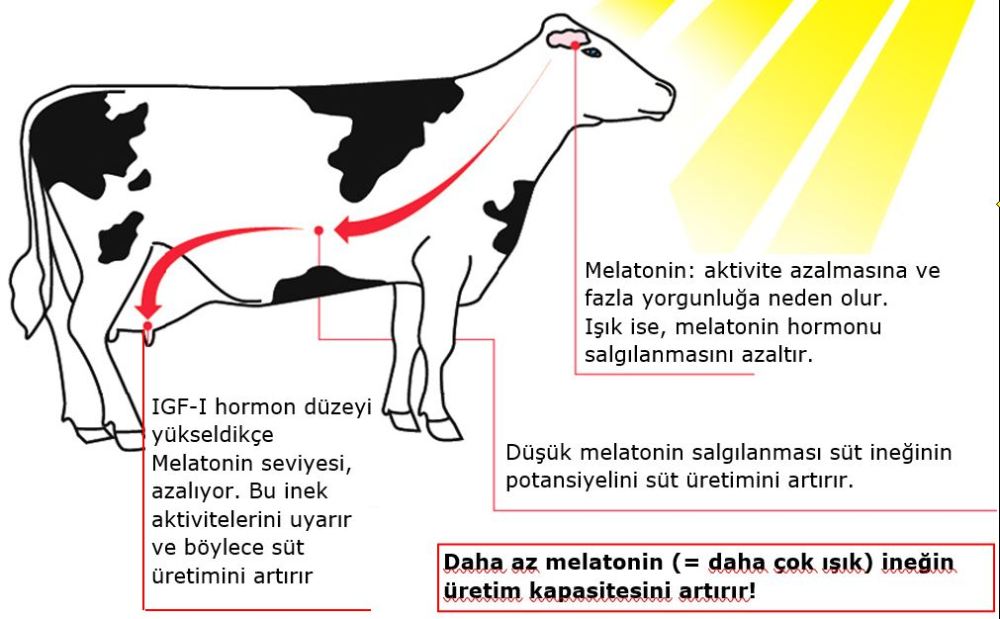
As IGF-I hormone levels increase, melatonin levels decrease. This stimulates cow activity, thus increasing milk production. Melatonin causes decreased activity and fatigue. Light, on the other hand, reduces melatonin secretion. Low melatonin secretion potentially increases milk production in dairy cows.
Using lighting to increase daylight hours affects the secretion of the sleep hormone melatonin: Light inhibits melatonin production and darkness accelerates it: longer light hours mean healthier and more active cows with less sleep hormone.
This lighting regime effectively mimics the long days of spring, when cows are naturally most active. The result: better feed intake and higher production. An inappropriate light level or lighting regime directly impacts your animals’ health, performance, and well-being.
Less melatonin (= more light) increases the cow’s production capacity!
The positive effect of a long photoperiod on milk production!
Effect of red light
Scientific research shows that dairy cattle perceive very little red light and are therefore not disturbed by it while resting at night. With a red LED light, you can monitor your cattle in the dark without disturbing them or disrupting their hormone balance.
MORE LIGHT, MORE MILK
A 16-hour lighting regime of at least 150 lux followed by 8 hours of darkness (maximum 5 lux) will improve both the welfare and productivity of cattle.
AgriLight Products
AgriLight luminaires were developed specifically for livestock housing and agricultural buildings. Each fixture is optimally resistant to moisture, ammonia, and dust.
Agril-ight offers a range of solutions to achieve optimal light levels.
- AGRILED® pro series; complete LED lighting AGRILED® pro 32 AGRILED® pro 16
- AL2007 / AGRILED® red series; conventional lighting
AGRIBOX pro
The AGRIBOX Pro provides fully automatic light management of the luminaires using a DALI signal. A digital light sensor dims or deactivates the luminaires when daytime light levels are sufficient. This contributes to a better climate in the barn and saves energy costs. The AGRIBOX Pro Switch completes your installation. This Switch de-energizes the luminaires for service and maintenance purposes.
AGRIBOX Pro and switch options
Together with AGRIBOX pro and AGRIBOX pro Switch you create an intelligent light management system,
which will contribute to animal welfare and energy savings due to features including dimming functionality.
Agrilight developed the AGRIBOX to control the optimal functionality of AL2007 and AGRILED® red fixtures. Integrated pre-programmed timers can be used to set a light schedule per group. Two light sensors can independently control maximum light levels.
AGRILED® pro series
These LED fixtures have been specifically developed using the latest LED technology and are therefore eligible for subsidies. The latest LED technology can help you save up to 60% on your energy bills.
AL2007 / AGRILED® red series
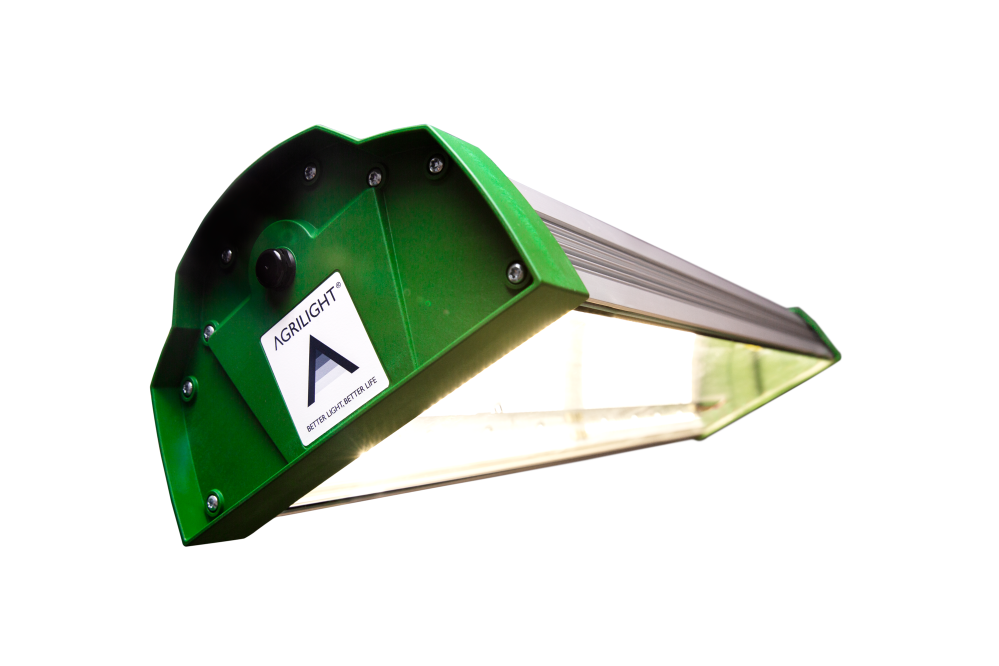
It is available with a High Pressure Sodium (HPS) or Ceramic Evacuated Metalhalide (CDM) 250 and 400 watt lamp. High Pressure Sodium emits yellow light, providing high light output and therefore high efficiency. Metal Halide emits white light and has a lower light output than the HPS model. The brighter white of the MH light means better color recognition compared to the HPS lamp. Both models are available with an integrated red control light; AGRILED® red.