
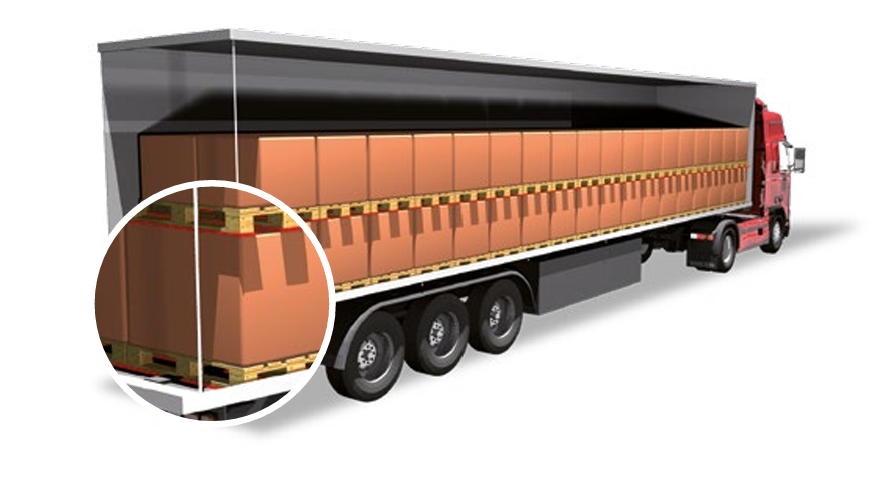
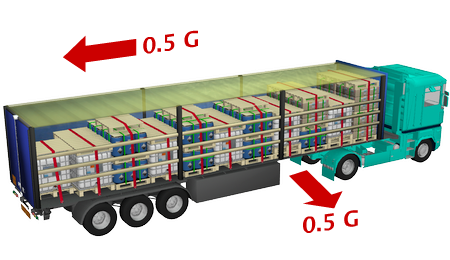
Description
KARGOTEC® anti-slip mats
With their high kinetic friction coefficient, the anti-slip mats KARGOTEC® basic, special plus, protect and secure reduce the sliding properties on smooth loading surfaces. The danger of freight slipping is decreased and the required tensioning force for lashing is significantly reduced, which also reduces the number of lashing straps needed. This saves both time and costs. Therefore, the anti-slip mats KARGOTEC® basic, special plus, protect and secure are an ideal supplement to lashing straps for securing loads and can be used under any type of load. Anti-slip cargo mats are EPD ( Environment Product Declaration) certified
What are anti-slip mats?
- With their high kinetic friction coefficient, the antislip mats KARGOTEC® basic, spezial plus, protect and secure reduce the sliding properties on smooth loading surfaces. The danger of freight slipping is decreased and the required tensioning force for lashing is significantly reduced, which also reduces the number of lashing straps needed.
- Sheet 15 of VDI 2700 defines the requirements for anti-slip mats. An anti-slip mat is of sufficient quality and strength if a tensile strength of at least 0.6 Newtons per square millimetre (N/mm²) is achieved and the elongation at break is at least 60%. Slip-resistant materials (RHM) or or anti-slip mats must be tested by an independent institute and can then be used until they reach the replacement state of wear.
KARGOTEC® anti-slip mats can always be re-used many times. However, there are criteria that rule out their continued use. These criteria are defined in VDI 2700 Sheet 15 and must be checked before every use of the anti-slip mats. If any of the following statements apply to the anti-slip mats, it has reached the “replacement state of wear” and may no longer be used:
- Permanent deformations or compression marks
- Tears
- Surface abrasion
- Holes
- Swollen areas
- Damage due to contact with aggressive substances
- Embrittlement
- Soiling that affects the function of the mats
Which advantages do KARGOTEC® anti-slip mats have?
- Wear-resistant, durable, re-usable up until replacement state of wear
- Durable solution
- Tested safety, high quality
- High kinetic friction coefficient
- Made of recycled material
- Fast and easy to handle, therefore time-saving
- Cost-saving through reduction of need for lashing straps.
KARGOTEC® basic
Our all-rounder for standard applications
Maximum permissible surface load:
100 t/m² for 3 mm, 120 t/m² for 8 mm (max. 30 % compression is permissible acc. to VDI 2700, sheet 15)
Coefficient of sliding friction:
- μ=0.7 measured coefficient of friction
- μ=0.6 practice-related calculated value
KARGOTEC® spezial plus
Our upgrade for increased surface loads
Maximum permissible surface load:
180 t/m² for 3 mm, 290 t/m² for 8 mm (max. 30 % compression is permissible acc. to VDI 2700, sheet 15)
Coefficient of sliding friction:
- μ=0.8 measured coefficient of friction
- μ=0.6 practice-related calculated value
KARGOTEC® protect
Our solution for demanding loads
Maximum permissible surface load:
270 t/m² for 3 and 8 mm (max. 30 % compression is permissible acc. to VDI 2700, sheet 15)
Coefficient of sliding friction:
- μ=0.9 measured coefficient of friction
- μ=0.6 practice-related calculated value.
KARGOTEC® secure
Extremely heavy loads perfectly secured
Maximum permissible surface load:
500 t/m² for 8 and 10 mm (max. 30 % compression is permissible acc. to VDI 2700, sheet 15)
Coefficient of sliding friction:
- μ=0.8 measured coefficient of friction
- μ=0.6 practice-related calculated value
Who is responsible for securing the load?
- According to public law (Section 22 of the German Highway Code), the driver, the loader and the hauler are responsible for securing the load. The vehicle operator is obligated to equip the vehicle in accordance with Section 31 of the German Highway Code.
- According to commercial law (Section 412 of the Uniform Commercial Code (UCC)) the dispatcher and carrier are responsible. According to Section 412 UCC the dispatcher is responsible for safe loading for transport. According to Section 412 UCC the dispatcher is responsible for safe loading for operation.




Reviews
There are no reviews yet.