
Milking routine
July 26, 2023Dairy cow milking & milking routines
A good milking routine in a clean environment will help reduce the risk of mastitis spreading in your herd. A good milking routine is critical to producing high-quality milk. Cows will milk faster and give more milk, you’ll have better milk quality, and you should see less mastitis. The aim of a good milking routine is to put the teat cups on calm cows with clean, dry, well-stimulated teats, to remove milk rapidly, and to remove the teat cups as soon as the cow has finished milking.
Pre-milking procedures
Aim for a prep-lag time of between 60 and 120 seconds between first stimulating the teats and attaching the units. This synchronizes milking out the alveolar milk (high up in the udder tissue) with the cisternal milk (in the udder just above the teat), and cows will milk out cleaner and faster. This reduces the risk of stop-start milking (bimodal or biphasic milking) and reduces new infection risks, as well as being nicer for the cow.
Two-step process
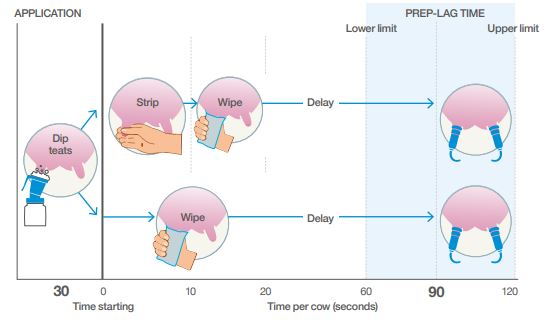
- Dip and strip
- Wipe and apply
Dip and strip
- Contact time – the length of time the pre-dip has been in contact with the teat before drying off: 30 seconds is the minimum recommended time.
Wipe and apply.
- Prep-lag time – the interval between manual stimulation and cluster attachment: this should be between 60 and 120 seconds.
Prep lag time is the 60–120 second interval between the first stimulation of a cow’s teats (stripping/cleaning) and attaching the milking unit. This delay ensures maximum oxytocin release, optimizing milk letdown, reducing milking time, preventing bimodal flow, and lowering mastitis risk by improving teat health.
Key Aspects of Prep Lag Time
Optimal Duration: 60 to 90 seconds is generally considered ideal, with a maximum window of up to 120 seconds for full letdown.
Physiological Reason: The stimulation triggers oxytocin release, which causes muscle contraction around the alveoli, pushing milk into the cistern. This process takes about 60 seconds to complete.
Too Short (<60s): Attaching too soon causes “bimodal” milk flow (high initial flow, then a drop) because the oxytocin hasn’t pushed all the milk down yet. This can lead to lower production, increased unit-on time, and potential teat damage.
Too Long (>120s): If too much time passes, the oxytocin level drops, leading to incomplete milkout and reduced parlour efficiency.
Best Practices:
Perform 10–20 seconds of physical stimulation (stripping, cleaning, or drying) to start the clock.
Maintain a consistent routine to maximize efficiency and animal comfort.
Keep the environment calm to avoid inhibiting oxytocin release
A good milking routine
- Wear disposable gloves.
- Give pre-milking teat disinfectant enough time to work–at least 30 seconds.
- Allow a lag time of 60–120 seconds from manual stimulation to cups on
- Put teat cups on calm cows with clean, dry teats.
- Ensure the majority of the teat skin of every teat is completely covered with post-milking teat disinfectant at the end of every milking.
Trouble shooting!
A problem and need advice – When I milk with the machine, one of the four teats of the cow does not release all the milk. Do you have any idea what can cause that? The pressure is correct at 400 constantly. The pipes are not tangled. Tips and advice needed?
Severe mastitis can lead to thickened milk which can block the teat, partially or completely. If treated with antibiotics early on, the cow’s milk will return to normal and milk will come out of the teat easily again. Surgery is not required to fix a blocked teat due to mastitis.
How do you know if a cow has mastitis?
Clinical mastitis infection is relatively easy to diagnose with the naked eye; redness or heat from the udder and defects in foremilk such as blood, flakes, clots or a watery appearance are sure signs that the cow has mastitis.
How do you treat a blocked teat in cattle?
They may be removed by forced pressure downward on the teat cistern or by use of specialized instruments inserted through the streak canal. Membranous obstructions in the area of the annular fold at the base of the gland cistern sometimes occur in heifers. Treatment of these obstructions is generally unsuccessful.
Reducing the risk of mastitis spreading during milking.
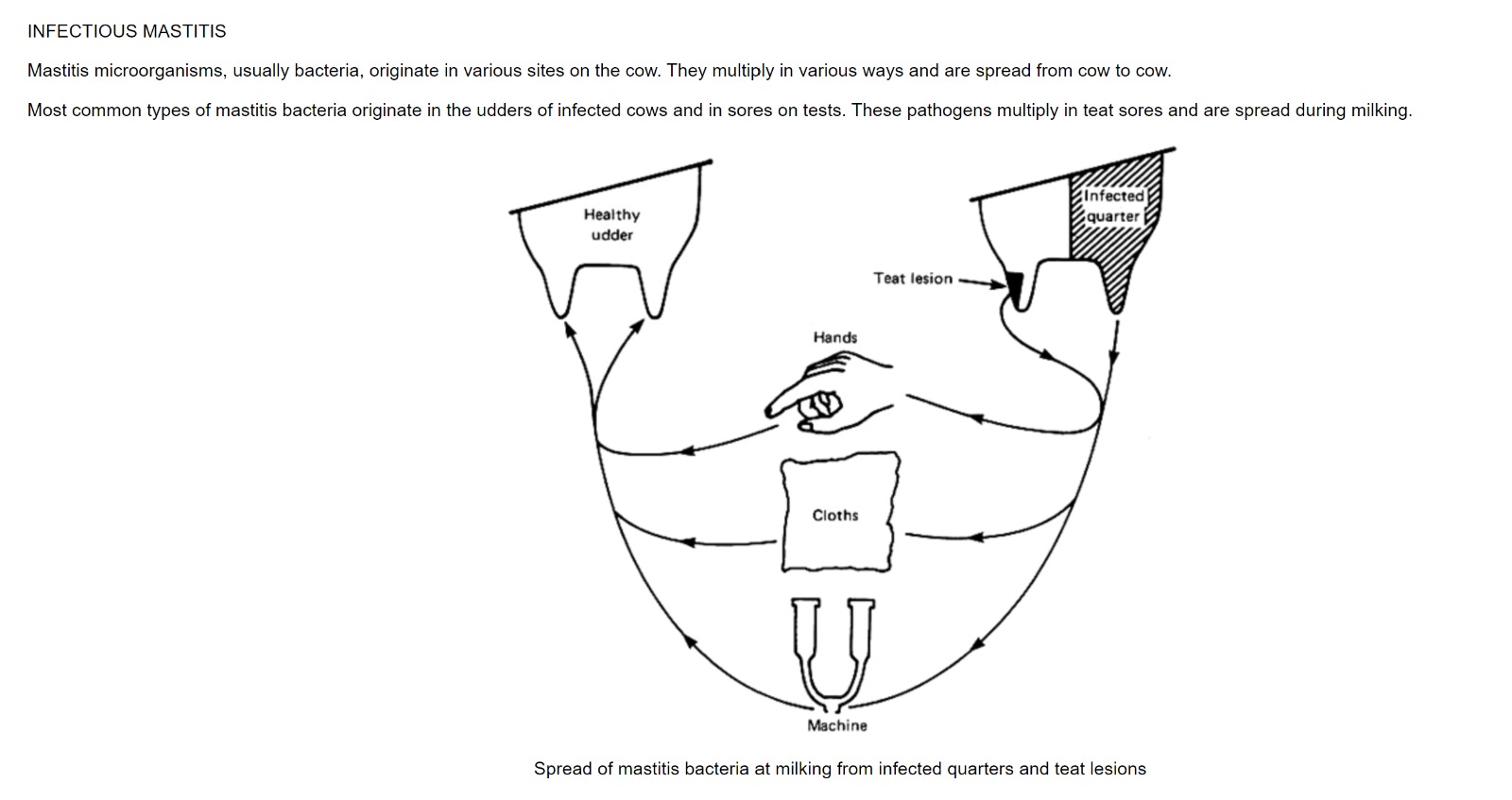
Contagious mastitis can easily be spread by milking equipment and even by the milkers themselves. Bacteria in milk from infected quarters can spread to other quarters by:
- Splashes and aerosols of milk during stripping
- Milkers’ hands and old pairs of non-disposable gloves
- Teat cup liners
- Cross-flow of milk between teat cups
The main aim is to put clusters on clean, dry teats. Wash the teats, then wipe them dry with a clean dry cloth or towel. Only use single-use towels to avoid bacteria transferring between cows.
Milking routine best practices
- Clearly mark cows with clinical mastitis, as well as those treated with antibiotics or with a high SCC
- Consider a dry wipe to remove dry dirt (helpful if bedded on sand or manure)
- Pre-dip the teats and give the product enough time to work. To avoid residues, only use licensed products and follow the manufacturer’s recommendations.
- Foremilk, checking for any signs of mastitis or irregularities in the milk.
- Prep-lag time of 60–120 seconds from manual stimulation to attachment
- Wash grossly soiled teats, wipe off the pre-milking teat dip (PrMTD) and wipe dry with a clean dry cloth or towel. Leave the disinfectant on until just before attaching the units.
- Attach the cluster unit, ensuring the clusters are squarely attached, aligned and balanced centrally. If you have automatic cluster removers (ACRs), pull the cord, so it is not under tension. Never apply weights to clusters
- Wash and dry hands and gloves during milking if they become dirty or splashed with milk. If cluster units fall off and get dirty, clean in warm disinfectant solution.
- If you don’t have ACRs and you’re removing the cluster by hand, pinch off the vacuum and wait a few seconds for the vacuum to drop. Before the cluster falls off, twist the claw to break the seal and remove the cluster.
- Never pull off the cluster under vacuum
- Never break the vacuum at the mouthpiece of the liner
- Apply post-milking teat disinfectant, regularly checking that the majority of the teat skin of every teat is completely covered at the end of every milking.
Milk yield based on very simple aspects cow 50% + Feed 25% + comfort 15% + milking 5% + others 5%